Managing input VAT for a mixed-use property requires more than applying 5% VAT to every supplier invoice. Property managers must identify whether each expense supports commercial units, residential units or shared areas—and post the tax to the correct account.
For buildings containing both commercial and residential units, incorrect classification can lead to overclaimed input VAT, missed recoverable VAT or an unclear audit trail. AQARAT, integrated with ERPOne, helps organizations apply a controlled procurement-to-accounting workflow from the Local Purchase Order (LPO) through to the Purchase Invoice and General Ledger.
Why mixed-use property VAT needs special attention
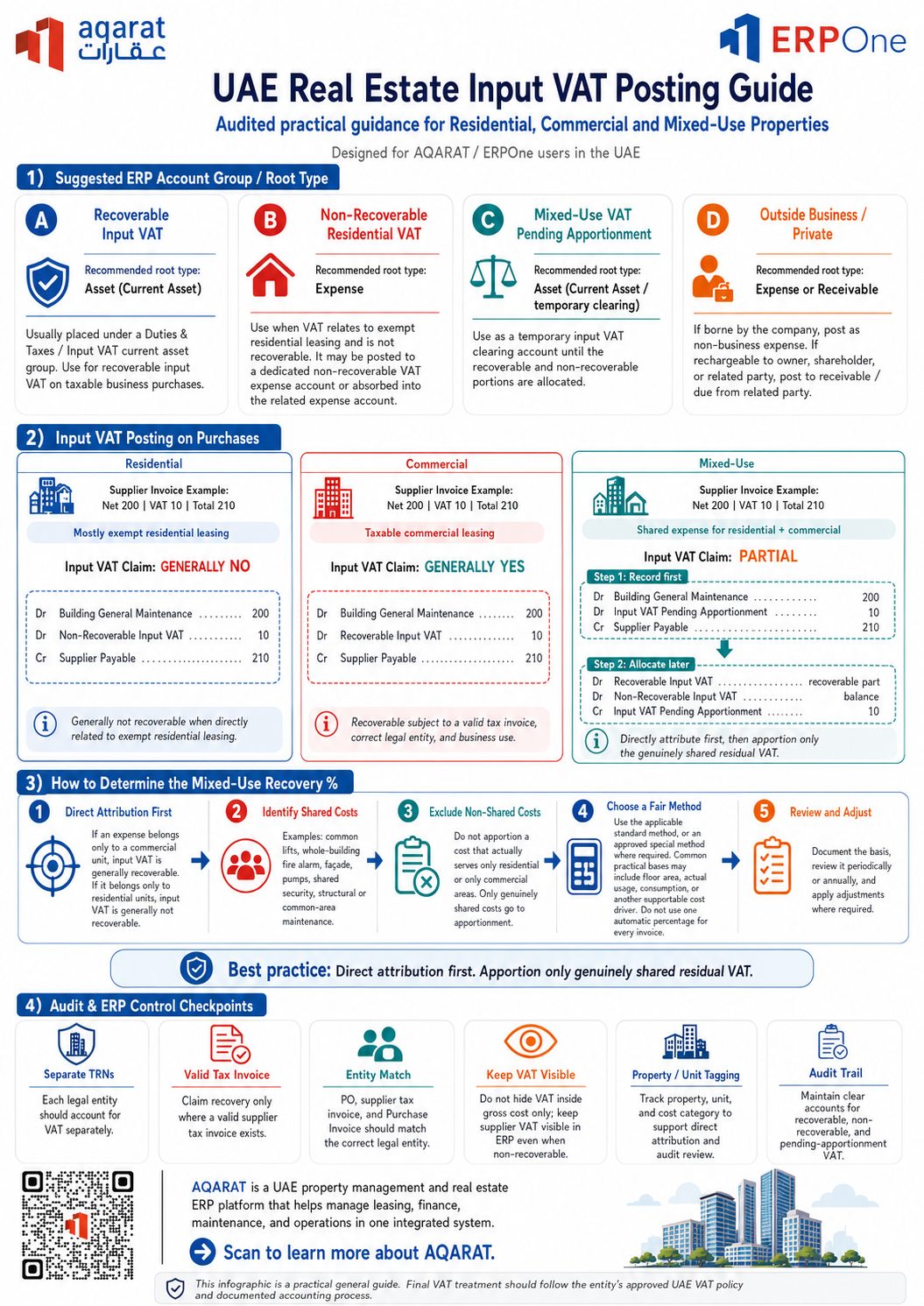
A mixed-use property may combine retail shops, offices, residential apartments and common facilities such as lifts, façades, roofs, fire-alarm systems and entrances. The VAT treatment depends on how the purchased goods or services are used.
Under UAE VAT rules, input tax associated with taxable supplies is generally recoverable, subject to the normal recovery conditions. Input tax relating wholly to exempt supplies is generally not recoverable. Where an expense supports both taxable and exempt activities, only the eligible portion of the residual input tax may be recovered.
The correct sequence is therefore:
- Directly attribute the expense wherever reasonably possible.
- Separate wholly recoverable input VAT.
- Separate wholly non-recoverable input VAT.
- Apportion only the genuinely shared or residual input VAT.
This means a business should not apply one building-wide percentage to every supplier invoice when the expense can be linked directly to a specific property area or unit.
Commercial, residential and shared expenses
Expenses related directly to commercial units
Commercial property supplies are generally subject to VAT at the standard rate. Input VAT on qualifying expenses incurred for taxable commercial leasing is therefore generally recoverable.
- Repairing an air-conditioning unit serving a retail shop;
- Replacing an office entrance door;
- Maintenance performed exclusively inside a commercial unit; or
- Professional services directly associated with taxable commercial leasing.
Recovery remains subject to the usual requirements, including business use, the correct legal entity, possession of a valid tax invoice and the absence of a specific input-tax restriction.
Expenses related directly to residential units
The subsequent sale or lease of residential property is generally exempt from VAT. Input VAT on repair, maintenance and other expenses directly related to such exempt residential leasing is therefore generally not recoverable.
- Plumbing work performed inside a residential apartment;
- Repainting a residential unit between tenancies;
- Repairing equipment used exclusively by residential units; or
- Letting expenses directly connected to exempt residential leasing.
The VAT should remain visible in the accounting records even when it is not recoverable. It may be posted to a dedicated non-recoverable VAT expense account or included in the related expense or asset cost, depending on the organisation’s approved accounting policy.
Expenses shared by commercial and residential areas
Some expenses cannot reasonably be assigned entirely to one category, including roof or façade repairs, whole-building fire-alarm maintenance, shared pumps, security, common-area cleaning and lifts serving both commercial and residential floors.
The VAT on these expenses is residual input tax. It should be placed under controlled review and apportioned using the applicable method.
The standard UAE method is based on the relationship between wholly recoverable and wholly non-recoverable input tax—not automatically on rental income, number of units or floor area. A special method, such as floor space, may be more representative for certain real estate businesses, but generally requires written FTA approval before use. See the FTA Input Tax Apportionment Guide.
Configuring VAT accounts in AQARAT and ERPOne
A clear Chart of Accounts is the foundation of reliable VAT reporting. The following structure is recommended, subject to the organisation’s accounting policy and tax-adviser approval.
| Account | Recommended root type | Purpose |
|---|---|---|
| Recoverable Input VAT | Asset—normally Current Asset | Holds input VAT eligible for recovery through the VAT return. |
| Non-Recoverable Input VAT | Expense | Records VAT that cannot be recovered and remains a business cost. |
| Input VAT Pending Apportionment | Asset—normally Current Asset, or a temporary clearing account | Temporarily holds VAT on genuinely shared expenses until allocation. |
Accounts used in an ERPOne Purchase Taxes and Charges Template should also carry the appropriate tax-account classification. Separate ledgers should be maintained for each legal entity or VAT registration where required. Expenses and VAT must not be transferred between property-owning entities merely because they are managed through the same platform.
Create separate Purchase Tax Templates
AQARAT and ERPOne users can establish two core Purchase Taxes and Charges Templates, with a controlled third template recommended for genuinely shared expenses.
1. UAE VAT 5%—Recoverable
Points to the Recoverable Input VAT account under Current Assets.
Use when the expense is directly connected to taxable business activities, such as maintenance exclusively for a commercial unit.
2. UAE VAT 5%—Non-Recoverable
Points to a dedicated Non-Recoverable Input VAT expense account, or follows the approved policy for adding irrecoverable VAT to cost.
Use when the purchase relates wholly to exempt residential leasing or another activity that does not permit recovery.
3. VAT Pending Apportionment
Directs supplier VAT on genuinely shared expenses to a temporary clearing account.
After review, reclassify the balance between Recoverable Input VAT and Non-Recoverable Input VAT.
The third template prevents users from claiming 100% of shared VAT prematurely—or treating all of it as non-recoverable without analysis.
From LPO to Purchase Invoice: the AQARAT workflow
-
Identify the property and unit
Before preparing the LPO, identify the correct legal entity, property and unit, expense category, intended use and supplier. Property and Unit accounting dimensions provide the transaction-level classification needed for direct attribution and audit review.
-
Create the LPO in ERPOne
Select the appropriate Purchase Tax Template based on the intended use of the expense:
- Commercial unit: Recoverable VAT template;
- Residential unit: Non-Recoverable VAT template;
- Shared building service: Pending Apportionment template.
The procurement stage is a key control point. VAT classification should not be left until VAT-return preparation, when the operational context may no longer be clear. Learn more in the ERPNext Purchase Taxes and Charges documentation.
-
Send the approved LPO to the supplier
The approved LPO communicates the authorised scope, property reference, price and expected VAT treatment. The LPO itself does not establish the final right to recover VAT; recovery still depends on the actual supply, its business purpose and receipt of a valid tax invoice issued to the correct legal entity.
-
Create the Purchase Invoice from the LPO
Creating the Purchase Invoice directly from the LPO carries forward supplier details, items and services, Property and Unit dimensions, expense accounts, values and the selected Purchase Tax Template.
The accounts team should match the invoice against the LPO and evidence of delivery or completion, then verify the supplier TRN, invoice date, VAT amount, customer legal name and all required tax-invoice particulars.
-
Submit and post to the General Ledger
Upon submission, the Purchase Invoice posts the accounting entries to the General Ledger. It does not normally create a separate Journal Entry document.
Illustrative accounting entries
Assume maintenance costs of AED 10,000 plus AED 500 VAT.
Commercial-unit maintenance
| Account | Debit (AED) | Credit (AED) |
|---|---|---|
| Maintenance Expense | 10,000 | — |
| Recoverable Input VAT | 500 | — |
| Supplier Payable | — | 10,500 |
Residential-unit maintenance
| Account | Debit (AED) | Credit (AED) |
|---|---|---|
| Maintenance Expense | 10,000 | — |
| Non-Recoverable Input VAT | 500 | — |
| Supplier Payable | — | 10,500 |
Alternatively, the AED 500 irrecoverable VAT may be included in the maintenance cost if that treatment forms part of the approved accounting configuration.
Shared expense pending review
| Account | Debit (AED) | Credit (AED) |
|---|---|---|
| Shared Maintenance Expense | 10,000 | — |
| Input VAT Pending Apportionment | 500 | — |
| Supplier Payable | — | 10,500 |
Once the approved apportionment has been calculated, the pending balance is reclassified between recoverable and non-recoverable VAT.
How AQARAT strengthens VAT control
AQARAT and ERPOne do not decide the legal VAT treatment on behalf of the taxpayer. They help the organisation apply its approved VAT policy consistently.
- Early VAT classification at procurement stage
- Separate VAT accounts and templates
- Property and Unit tagging
- Continuity from LPO to Purchase Invoice
- Supplier and legal-entity controls
- Clear General Ledger postings
- Visibility of VAT pending apportionment
- Document references and approval history
These controls reduce dependence on spreadsheets and allow accountants, property managers, auditors and tax advisers to trace a VAT amount back to the supplier invoice, LPO, property and unit.
Common mistakes to avoid
- Recovering all VAT merely because the supplier charged 5%;
- Treating every expense in a mixed-use building as partially recoverable;
- Applying a floor-area percentage without confirming that the method is permitted;
- Hiding non-recoverable VAT inside gross costs without a clear audit trail;
- Using the wrong legal entity or TRN;
- Omitting the Property or Unit dimension;
- Claiming VAT without a valid tax invoice; and
- Changing VAT treatment after submission without an approved correction process.
Frequently asked questions
Is all input VAT relating to residential property non-recoverable?
No. VAT on costs directly associated with subsequent exempt residential leasing is generally not recoverable. Different treatment may apply to the zero-rated first supply of a new residential building, development costs, taxable services or other specific circumstances.
Is VAT on commercial property expenses always recoverable?
Not automatically. The expense must relate to supplies permitting recovery and satisfy the normal input-tax recovery requirements. Blocked, private or non-business expenses may remain non-recoverable.
Can the commercial floor percentage be used for every shared invoice?
Not by default. Direct attribution comes first. The standard input-tax apportionment method applies unless the business has obtained permission to use an eligible special method, such as floor space.
Does an LPO create an accounting entry?
Normally, no. The LPO records the procurement commitment and VAT classification. The accounting impact arises when the Purchase Invoice is submitted.
Should one VAT template be set as the default?
For a mixed-use property portfolio, defaulting every purchase to one treatment can increase classification errors. It may be safer to require deliberate selection or implement controlled rules based on property, unit and expense type.
Build a more reliable property VAT process
See how AQARAT brings property management, maintenance, procurement, accounting and UAE VAT controls together in one integrated platform.
Book a Free DemonstrationDisclaimer: This article provides general information and does not constitute legal or tax advice. VAT treatment depends on the facts of each transaction, the taxpayer’s activities and the latest UAE legislation and FTA guidance. Businesses should confirm their accounting and apportionment policies with a qualified UAE tax adviser.